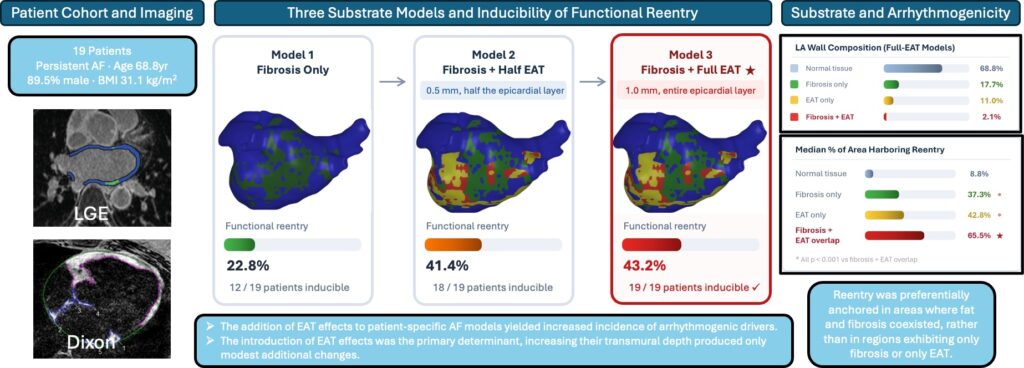
We’re excited to share a new paper from our collaboration with Dr. Nazem Akoum’s group in UW Cardiology, led by Dr. Yaacoub Chahine: “Substrate Comprising Fibrosis and Epicardial Adipose Tissue-Associated Electrophysiological Remodeling Can Sustain Atrial Fibrillation Drivers: Insights from Image-Personalized Computational Simulations” in Heart Rhythm (also available on PubMed Central).
Image-based atrial models usually account for fibrosis but not for the epicardial adipose tissue (EAT) surrounding the atria, and arrhythmia often can’t be induced in them at all. Using MRI from 19 patients with persistent AF, we built personalized left atrial models with and without EAT effects (855 simulations in total).
Key findings:
- Adding EAT effects roughly doubled the inducibility of functional reentry, from 22.8% to 43.2% of simulations, and made all 19 patient models inducible (versus 12 of 19 with fibrosis alone).
- Reentrant drivers anchored preferentially where fibrosis and EAT effects overlapped. These regions made up only about 2% of the atrial wall, yet a median of 65% of their volume harbored reentry.
- In an exploratory analysis of 13 PVI-only patients, overlap outside the standard PVI region was associated with 1-year recurrence. This is a preliminary, hypothesis-generating result in a small cohort.
We see this as a step toward more realistic atrial digital twins. The work was supported by the NIH (R01-HL158667, T32-EB001650), the ARCS Foundation, and the John Locke Charitable Trust.