
We are very proud to announce the publication of new research from the CardSS Lab and our collaborators on the use of artificial intelligence-enhanced electrocardiography and electronic health record data to predict out-of-hospital cardiac arrest. Congratulations to first author Dr. Surbhi Sharma and thank you to our outstanding collaborators, including co-senior authors Dr. Neal Chatterjee and Dr. Shaan Khurshid.
This paper, published in JACC: Advances, tackles a major challenge in cardiovascular medicine: how can we identify people at elevated risk of out-of-hospital cardiac arrest before the event occurs? Cardiac arrest often strikes suddenly, and many cases occur outside the hospital in people who are not already known to be at especially high risk.
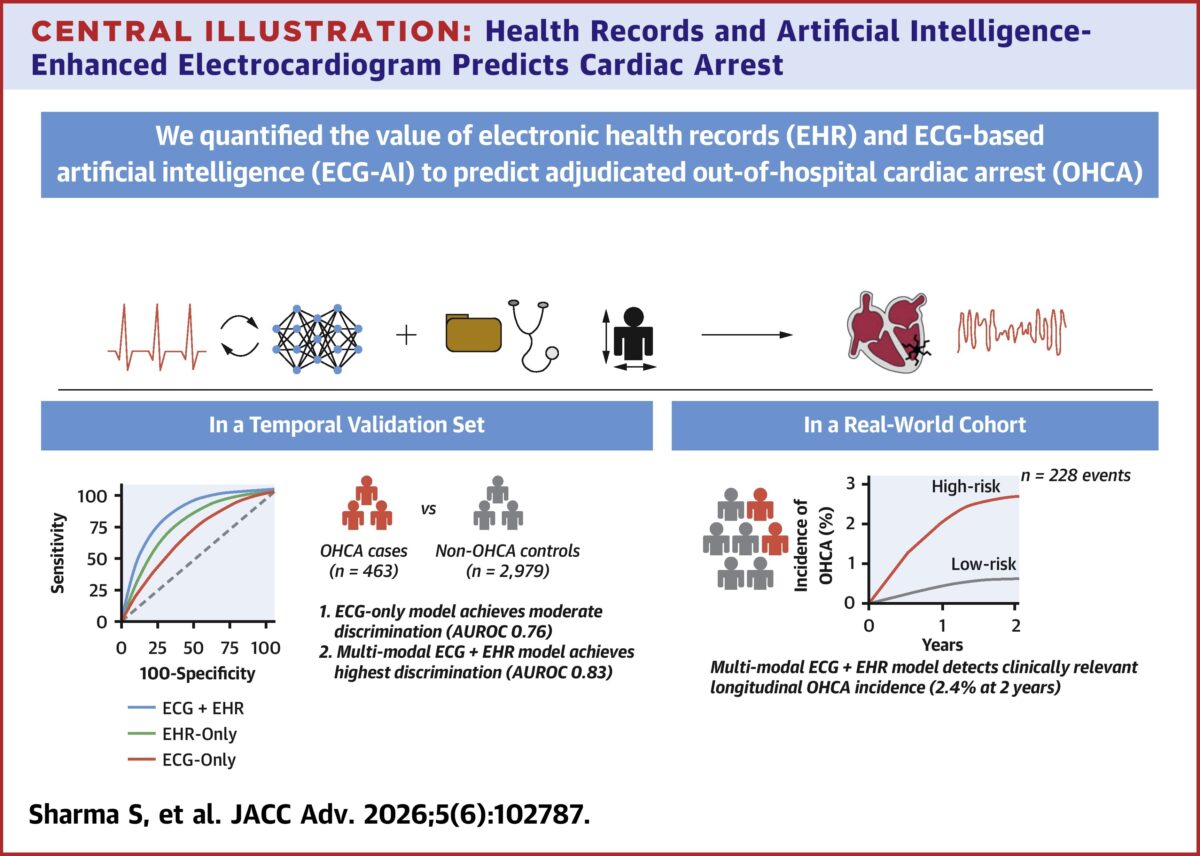
The results are exciting. The combined electrocardiogram + electronic health record model achieved the strongest performance in temporal validation and identified a high-risk group in a real-world cohort of nearly 40,000 patients undergoing routine electrocardiography. Over two years, the incidence of out-of-hospital cardiac arrest was substantially higher in the model-designated high-risk group than in the low-risk group.
This work is a major step toward understanding how routinely collected clinical data can be used to improve cardiac arrest risk stratification. It also highlights the power of combining machine learning, clinical informatics, emergency medical services data, and cardiovascular engineering to tackle problems with real-world public health impact.
We are extremely grateful to the entire team for making this work possible, and we are very excited to see this important paper out in the world!